Budgeting for a Celebration with More Than One Setup
A celebration can have one name and several distinct setups. A wedding may include a ceremony and reception, a family gathering may continue the following day, or a company event may use a welcome area, presentation room and evening reception. The budget needs to recognize those separate settings without assuming that every location requires a completely new design.
The most useful approach is to map the event by place and time, then identify which pieces stay, which repeat and which might move. Only after that should you compare the cost of reuse with the cost of separate installations. A piece available at the first event is not automatically ready for the second one at the right time.
Event Creation’s event planning service can be discussed alongside decoration for multi-part occasions. This guide focuses on building a clear financial scope: how to account for the different setups, avoid counting the same item twice and request alternatives that reflect the actual sequence of the celebration.
Map each setup as its own line of the event
Write down every place where decoration or a guest service is required. Add the date, room, ready time and end time for each. Keep the list factual before filling it with design ideas. This helps reveal the true number of setups hidden inside the overall occasion.
A ceremony room and a reception room at the same venue are still separate locations if both need to be ready at different times. An entrance display may be another area with its own purpose. A next-day gathering at a home should not be treated as an informal extension if rented pieces or professional setup are expected there.
Use this map as the structure of the quote request. It allows the team to identify where design, delivery, installation and collection are needed. It also gives you a way to compare proposals that might otherwise describe the entire celebration under one broad heading with unclear boundaries.
Assign a purpose to every location
Not every setup needs the same level of decoration. The ceremony may have a strong focal point, the reception may emphasize tables and the following day’s gathering may need only a smaller welcome feature. Decide what each location should accomplish for guests.
This prevents the budget from repeating a full decorative package simply because another room is involved. A secondary space may need continuity in colour without duplicating the main installation. Conversely, a separate event with its own important photographs may deserve an independent focal point.
Describe the purpose before asking which pieces can be shared. If the second setting has a different function, the original arrangement may not suit it. The best multi-part design is connected through a clear visual direction while allowing each location to do its own job.
Separate repeated items from shared items
A repeated item is supplied in more than one place. A shared item is intended to be used again. Those are different budget assumptions and should be labelled clearly. A quote for two centrepieces means two physical pieces; a quote for one arrangement moved later requires a transfer plan.
Use simple notes beside the item list: remains in place, supplied separately or proposed for reuse. The decorator can then confirm which reuse ideas are practical and what work they involve. Do not leave the distinction to be inferred from photographs or conversations.
This is especially important when two rooms are open at the same time. One sign or arrangement cannot serve both locations simultaneously. If the first room must stay complete while the second is being prepared, separate pieces may be necessary. The budget should reflect the actual overlap rather than an optimistic sequence that the program does not allow.
Check the timeline before counting a saving
Reuse works only when the first use ends early enough for the piece to reach its next position. Identify when guests leave the first area, when the team can begin work and when the second area must be finished. Include any period needed for photographs in the original setting.
Ask the supplier to assess the handling and installation required. You should not estimate the move from the distance between rooms alone. A large structure, attached decoration or a carefully styled arrangement may involve work that is not obvious to the host.
If the timing is tight, compare a simpler separate piece for the second location with the proposed transfer. The option using fewer physical items is not always the best value once the full work is considered. A complete quote makes the tradeoff visible instead of relying on a last-minute move to make the budget work.
Treat separate addresses as separate practical scopes
Moving between addresses introduces transport and access considerations that do not exist within one room. The team needs the full route of the event, including each venue’s arrival and collection requirements. A ceremony-to-reception transfer should be discussed as part of the service rather than assumed to happen between bookings.
Provide the address and relevant contact for every location. Identify whether pieces can be left in place, stored or collected later under the venue’s arrangement. Do not promise access to a room after your booking ends without confirming it with the venue.
Event Creation serves Toronto and the GTA, with event details reflected in the written quote. The fact that both locations are within the service area does not establish the handling or timing for a multi-location order. Ask for those details to be included so the total corresponds to the entire plan.
Keep the rental period visible
For a celebration spanning more than one day, clarify how long each rented item is required. A backdrop needed only for the first evening has a different role from a display expected to remain through a weekend program. The booking should state the agreed arrangement rather than leave it implied.
Ask which items are collected after each setup and which can remain under the agreed terms. If the venue offers storage between sessions, confirm that this arrangement is acceptable to the supplier and identify who controls access. Do not treat storage availability as automatic permission to move or handle rented equipment.
The event extras catalogue can help identify the pieces being considered, but the rental and service scope needs to match your dates. Keep the item list linked to the event map so you know when every piece is in use and when it is expected to be returned.
Distinguish design continuity from duplication
A multi-part celebration can feel connected without repeating the same installation in every setting. Consistent colours, related signs or a recurring floral style can create continuity while the scale changes to suit each room.
Ask the team to propose a visual relationship between the setups. The main event might receive the fullest backdrop, while a smaller gathering uses a simpler arrangement in the same palette. This can be a more coherent budget decision than trying to transport the main installation everywhere.
Avoid copying a large design into a smaller room merely because it has already been approved. The proportions and guest use may be different. A shared design direction gives each space a recognizable connection while allowing the quote to reflect its actual needs rather than a fixed package repeated without adaptation.
Give ceremony and reception flowers distinct roles
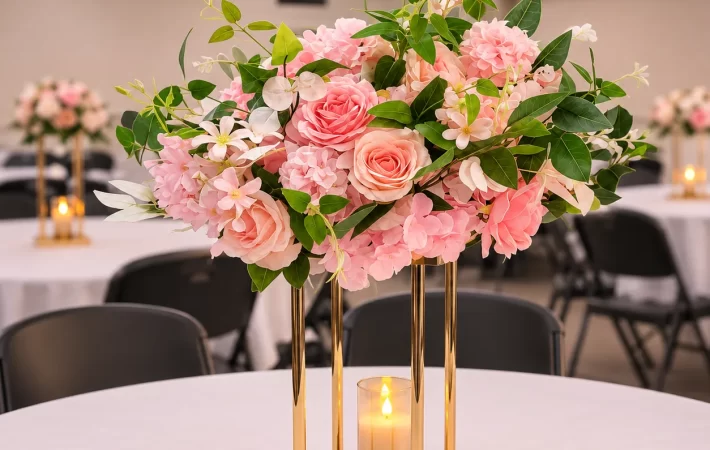
Fresh floral pieces may be candidates for reuse, but the plan should be assessed by the floral team. An arrangement designed for a ceremony focal point may not be suitable for a dining table or may need a different placement at the reception.
List the original and proposed later positions, along with the timing. Ask whether the arrangement can serve both purposes and what handling is included. The flower decoration service describes custom floral work and the possibility of considering ceremony pieces for later use, but the actual event still needs a specific proposal.
Keep personal flowers separate from room installations. Bouquets and other individual pieces may have their own schedule and recipients. A complete floral budget for a multi-part wedding should show these different roles clearly, so the same general phrase does not conceal several distinct orders or expectations.
Quote guest experiences by their actual sessions
A photo booth or entertainer used across several parts of an event needs a defined service schedule. Do not assume one booking automatically covers all rooms, dates or intervals in the program. Ask the provider to describe the scope appropriate to the selected format.
Identify when guests can use the service and whether there are gaps between sessions. The event may move from a daytime reception to an evening party, or the audience may change. Those details are relevant to the service proposal even if the overall celebration has one organizer.
Event Creation’s photo booth service can be discussed with the full program in view. Confirm the chosen setup, operating periods and any move between locations. A clear session-based description lets you compare options without inventing an hourly calculation that may not reflect the actual booking arrangement.
Keep setup labour separate from visual similarity
Two rooms may look similar in the final photographs but still require two separate installations. Matching colours do not eliminate delivery, assembly or placement work. Likewise, reusing the same sign may reduce duplication in materials without removing the work needed to install it in another setting.
Ask the quote to explain the service associated with each setup. You do not need a detailed account of the supplier’s internal costs, but you should understand whether the proposal includes one installation, several installations or an agreed move.
This distinction helps avoid frustration when a second setup does not cost as little as expected. The price reflects more than the decorative materials. If the total is above budget, discuss a simpler secondary setting or a design that remains in one place, rather than assuming visual similarity should make the second installation nearly effortless.
Decide who owns the transition between events
The interval between two event moments needs a responsible person. That person may coordinate access, tell the team when guests have left and confirm the next area’s readiness. It should be clear who carries that role before a move is included in the plan.
Do not leave the transition dependent on whoever happens to be nearby. Family members and venue staff may have other responsibilities and may not be authorized to handle rented pieces. If Event Creation is providing coordination, identify the relevant scope in the proposal. If someone else manages the transition, provide their contact details.
The budget question is whether the planned work has an owner and an agreed service arrangement. A transfer described as “we will move it later” is incomplete until “we” refers to a responsible party that has accepted the task. Clear responsibility makes the financial plan more credible.
Compare three practical versions of the celebration
For a complex event, it can help to request a small set of complete alternatives. One version might use separate setups for each location. Another might reuse selected suitable pieces with the required handling included. A third might concentrate the main decoration in one setting and simplify the others.
Keep the occasion, guest needs and essential moments consistent across the versions. Ask the team to identify the main differences in appearance and work. The comparison should show what each option delivers, not just a lower total with unclear omissions.
Choose the version that fits both the budget and the program. A theoretically efficient reuse plan may be less attractive if it adds a difficult transition during the celebration. A simpler independent second setup may give you a clearer event even if it uses more than one physical piece. Evaluate the complete experience and responsibilities together.
Allocate the budget by priority, not equal portions
There is no requirement to divide the decoration budget evenly between event parts. One moment may be more important for the host, more visible in photographs or longer in duration. The allocation should reflect those priorities rather than give each room the same amount for the sake of symmetry.
Discuss the hierarchy openly. If the ceremony is the central visual moment, explain that. If the evening reception is where most guests will spend their time, it may deserve greater attention. A smaller follow-up gathering can still feel connected through a few deliberate details.
This helps the decorator propose a coherent scope. Without priorities, every location can gradually acquire a full wish list. With priorities, the team can show where a fuller treatment belongs and where a restrained approach will serve the event. The budget becomes a design decision rather than a series of independent additions.
Plan a smaller version of the second event
A next-day or secondary gathering often begins as an informal idea and grows during planning. Before adding decoration, confirm whether it needs a distinct professional setup or whether the venue and a few host-provided details already support the occasion.
If you do want a quoted setup, describe it honestly. Give the date, space, guest count and desired ready time. Do not rely on the idea that the team is “already doing the main event” as a substitute for a scope. Separate work still needs to be understood and scheduled.
A modest second concept can be intentional and complete. It might use related colours and one small focal detail rather than imitate the main installation. Ask for a proposal that fits the scale of that gathering. This keeps the larger celebration’s budget from absorbing an unplanned second event through a chain of casual additions.
Use one budget record for shared decisions
When different relatives or departments fund different event parts, a shared piece can be counted twice or omitted from both budgets. Keep one record showing the total agreed scope and note how the group intends to allocate the spending internally. That allocation should not change what the supplier is being asked to deliver.
For a hypothetical ceremony and reception, the family may choose to assign a shared floral arrangement to the ceremony budget while the handling belongs to the combined event budget. Another group may allocate it differently. The important point is that the complete quoted amount appears once in the overall plan and that the parties understand their own contribution.
Separate internal cost sharing from the supplier’s booking and payment arrangements. Confirm the actual documents and responsible contact with the supplier rather than assuming several informal contributors create several separate orders. A single clear financial picture makes it easier to evaluate changes without losing track of which setup or service they affect.
Confirm the complete order in one current version
Before booking, review the event map against the final quote. Every setup should have a location, timing, item list and agreed service arrangement. Shared pieces should show their sequence, while separate pieces should have clear quantities.
Check that the proposal includes the relevant delivery, moves, installation and collection details. Mark any remaining venue answers as pending and identify who will obtain them. Keep the booking terms with the accepted scope, rather than relying on assumptions about rental duration or changes.
Contact Event Creation with your multi-part program and the priorities for each setting. Ask for a quote that follows the celebration from one location to the next. A clear map of what stays, repeats and moves allows the budget to support the entire event, with each setup understood before the first piece arrives.
Planning your own event? Share the date, venue and the look you want. We will contact you within 24 hours to talk through design ideas and pricing.