How to Reduce a Decor Quote Without Losing the Main Design
A decoration quote that exceeds your budget does not always require abandoning the whole idea. Often, the better next step is to identify what gives the design its character and ask how the surrounding scope can be simplified. The goal is a complete smaller concept, rather than the original concept with pieces removed at random.
That conversation works best when you are clear about two things: the amount you want the revised proposal to reach and the feature you most want to preserve. A decorator can then suggest meaningful changes to scale, quantity, materials or services. Asking for the same detailed installation at a lower total gives much less direction.
This guide explains how to review an Event Creation proposal thoughtfully. It does not promise that every design can meet every budget or that a particular change will produce a fixed saving. The actual result depends on the selected pieces and work involved. What you can do is make the priorities clear enough for a useful revision.
Name the part of the design you would miss most
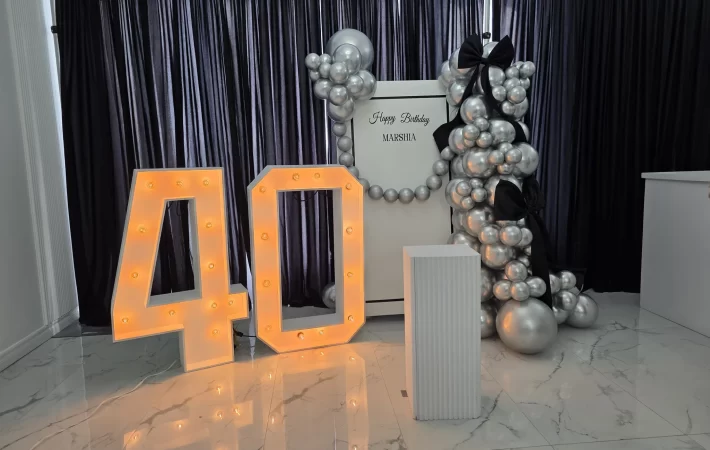
Look at the proposal and identify the main reason you liked it. Perhaps it is the broad photo background, a particular floral shape, the illuminated age numbers or the colour combination. Try to describe that quality without listing every item in the order.
This becomes the protected part of the brief. It tells the team which element should remain recognizable if the scope changes. If several people share the decision, agree on this priority before requesting a revision. Otherwise, one person may remove the flowers while another removes the backdrop, leaving no coherent direction.
It is also useful to distinguish emotional importance from visual habit. A personalized name may matter deeply to the host, while a second plinth may simply appear in the inspiration photograph. Treat those differently. The revision should preserve what gives the event meaning and reconsider details that were copied without a clear purpose.
State a usable budget boundary
Tell the team what the revised amount needs to cover. Is it decoration only, or decoration together with a booth, entertainment and other extras? Does it need to include the delivery and collection arrangement being discussed? A number without its scope can lead to another proposal that still does not fit.
If you have flexibility within a range, explain that too. Identify the amount you are comfortable with and the reason you might consider a higher option. This lets the team present a base design and a deliberate alternative rather than guessing how much each feature matters.
Use the event packages as a way to organize the conversation if the order includes several services. A simpler decoration level with one chosen activity may be more appropriate than a visually larger package. The right revision depends on what you want the complete event budget to accomplish.
Remove duplicate purposes before reducing quality everywhere
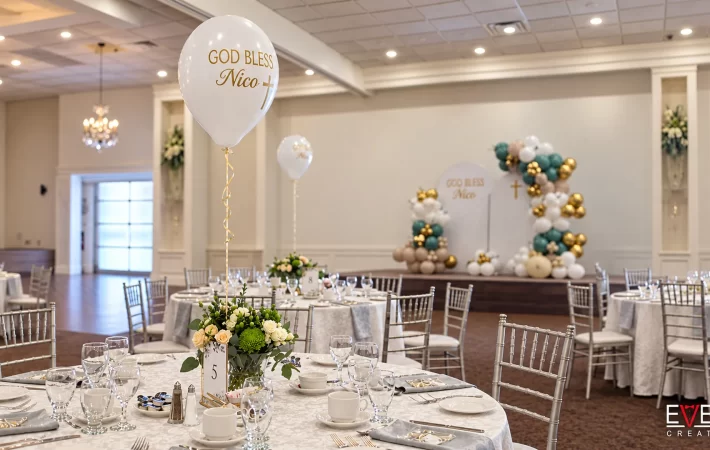
An event can contain several pieces doing essentially the same job. A name sign, custom balloon wording and illuminated letters may all personalize one photo area. Two nearby backdrops may offer nearly identical photographs. Removing duplication can simplify the order without weakening the central experience.
For each item, ask what guests gain from it that another selected feature does not already provide. Keep the answer practical. A welcome sign may guide arrivals while the backdrop sign appears in portraits, so both can have distinct roles. A third sign repeating the same message may be less important.
This review is more useful than asking every component to be slightly cheaper. Reducing all pieces at once can leave the whole room feeling underdeveloped. Removing a lower-priority feature entirely can preserve a stronger main setting and give the revised design a clearer visual hierarchy.
Concentrate the decoration where the event happens
A long list of decorated areas can spread the budget thinly. Review where guests will actually gather, sit and take photographs. The main celebration moment may deserve more attention than a corridor or secondary corner that people pass briefly.
Ask whether the design can concentrate on one complete focal area with coordinated table details. The balloon decoration service offers several ways to build that focal point, from garlands to decorated backdrops. The team can discuss which format suits the room and budget.
Concentration does not mean ignoring the venue. The focal area still needs to relate to the surrounding colours and layout. It means choosing where the strongest visual investment belongs. A deliberate centre of attention is easier to understand than many disconnected accents that each consume money without giving the event a clear place to gather.
Simplify the backdrop as a complete composition
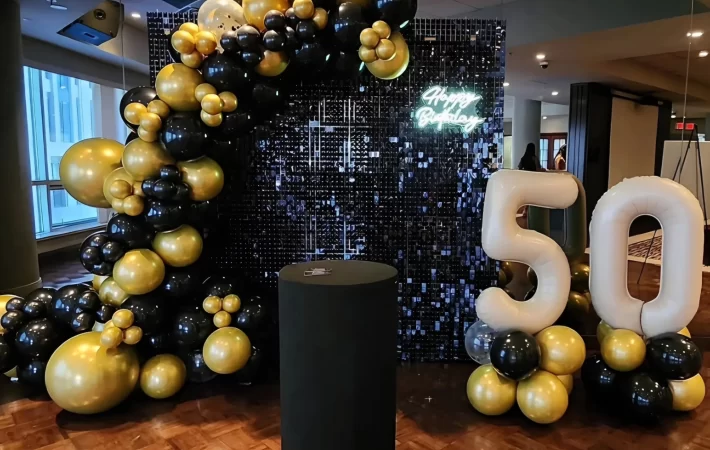
If the backdrop is the main priority, look at how it is built. There may be several panels, decorative layers, side pieces and personalized elements. Ask which of those are essential to its shape and which are optional extensions.
The answer might be a different panel arrangement, less decorative coverage or fewer adjacent pieces. The team should propose the revised composition as a whole. Avoid independently deleting components if you do not know how they support the design or structure.
Consider the photographs the backdrop must accommodate. A smaller installation may still work for couples or small groups but be unsuitable for a larger planned portrait. Tell the team the intended use so the revision saves scope without removing the function. The best lower-cost backdrop remains appropriate for the room and the people standing in front of it.
Reconsider the number of repeated pieces
Repeated decorations are often a clear place to examine quantities. Count the surfaces that truly need the selected treatment and distinguish them by purpose. A guest table, cocktail table and gift table may not need identical arrangements.
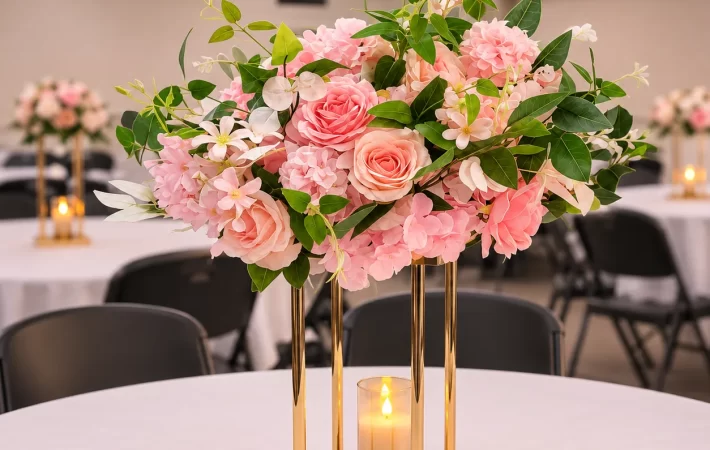
If every table currently has a substantial floral piece, ask whether a coordinated simpler treatment could work across the layout. Do not leave arbitrary tables undecorated unless that is an intentional part of the design. A consistent revised plan usually looks more considered than an uneven distribution of the original pieces.
The floral decoration service includes custom work and catalogue-related accents that can be discussed together. Request alternatives based on the actual table count and desired look. The quote should make clear what changes in quantity or treatment, so the lower total is understandable rather than simply reassuring.
Compare materials without assuming one is always cheaper
Fresh flowers, artificial florals, greenery, balloons and other decorative materials can create different versions of a concept. A material change may be worth discussing, but it should not be treated as a certain saving before the complete design is quoted.
Size, supporting structures, handling and installation remain part of the scope. A very large artificial installation may involve more work than a modest fresh arrangement. The useful comparison is between suitable alternatives for the same purpose, not between broad material labels.
Explain what visual quality you want to retain: softness, colour, texture, shape or a particular personal detail. Ask the team how that quality could be achieved within the revised budget. This opens a design conversation without asking for an imitation of a material or arrangement that is not appropriate for your event.
Keep personalization focused
Personalization can give a simple design a strong identity. It can also grow into several separate items that repeat the same information. Decide which name, age, message or brand element needs to lead the setting and where it will be most visible.
If the quote includes several customized pieces, ask whether one clear treatment can carry the message. Check how it works with the backdrop and the people in photographs. A sign that is readable and well placed can be more useful than several small personalized details scattered around the room.
Do not make wording decisions so late that the team has to redesign the setting around them. Once the preferred personalization is chosen, confirm the exact text and approval process. Focused customization helps the revised concept feel specific to your celebration even when the overall number of decorative elements is reduced.
Review extras as separate decisions
An event quote can exceed the target because of the combined extras rather than the core decoration. Look at booths, entertainment, display stations and other additions separately. Each should have a clear purpose and fit the program.
Event Creation’s event extras offer many possible enhancements, but you do not need to select all the ideas that appeal to you. Ask which additions serve a distinct guest need and which overlap with something already planned. Consider the available time as well as the price.
If an activity is the host’s priority, preserve it and simplify the decoration around it. If the event is mainly a dinner and portrait occasion, the visual setting may matter more. The revised quote should express that choice clearly rather than distribute small reductions across every service without considering what guests will actually experience.
Explore reuse only after checking the full work
Moving a piece between event moments can sound like an obvious saving. It may be useful, but only if the arrangement is suitable to move and the transition can be managed. Ask the team to assess the complete plan before counting a reused piece as a budget reduction.
Specify where it starts, where it goes and when the move would happen. A ceremony arrangement may not fit the reception position you have in mind. Separate addresses or a short transition window can introduce practical work that needs to be included.
Compare the quoted reuse option with a simpler separate treatment for the second location. The lowest material quantity is not always the least complicated or best-value plan. The objective is a design that works throughout the event, with the required handling understood, rather than a theoretical saving dependent on an unconfirmed move.
Use venue-provided items where they actually fit
The venue may already provide tables, certain furnishings or a visual feature that can be incorporated into the design. Ask what is available and share the specifications with the decorator. This can prevent unnecessary duplication in the proposed rental list.
Do not assume that a venue table is interchangeable with the one shown in the design. Dimensions, finish, placement and availability matter. A supplied item may need styling or may not support the intended composition. Let the team assess it before removing a quoted component.
Also confirm who places the venue-provided item and when it will be ready. A saving on a rental is not helpful if the decorating team arrives to find the essential surface unavailable. Incorporating existing resources works best when they are treated as defined parts of the event plan, with clear responsibilities and a confirmed appearance.
Avoid shifting hidden work onto yourself
Removing installation or styling from a quote may appear to lower the total, but it also transfers responsibility. Before choosing that approach, understand what you would need to collect, move, assemble, position or return. Confirm that the supplier offers the arrangement you are considering for the selected items.
Be honest about the time available on the day. Hosting, welcoming family, coordinating food and preparing for photographs can already fill the schedule. A lower invoice is not automatically better value if it creates work you cannot realistically complete.
If you want to contribute your own decorations, discuss a clear boundary. The team should know which pieces you are providing and whether any handling or styling is included. The revised plan should be a genuine division of responsibilities, not an assumption that the decorator will quietly absorb tasks removed from the quote.
Protect the practical requirements of the setup
Venue access, appropriate installation and agreed collection are part of making the design work. They should not be treated as optional details to delete without discussing the consequences. A smaller budget still needs a realistic plan for the actual room and schedule.
If the venue conditions make the chosen installation difficult, ask for a simpler design suited to those conditions. That is different from pretending the conditions do not exist. The supplier should determine how its pieces are installed and handled, with the venue’s requirements confirmed.
Keep the quote connected to the whole job. A reduction in decorative coverage may leave the basic transport and assembly work unchanged. Understanding that relationship helps you ask for revisions that could meaningfully affect the total instead of repeatedly removing minor accents while the main scope remains the same.
Ask for two clear versions rather than endless small edits
Once the priorities are established, request a concise comparison between the original proposal and a revised version that addresses the budget. If useful, add one middle option. Each version should describe a complete design and identify the main differences.
Avoid building a final order by combining isolated figures from several messages. A change to one component can affect another, and old totals may no longer apply. Ask for the selected version to be confirmed as one current proposal before approving it.
When reviewing the options, describe what you gain or give up in each. Perhaps one version preserves the larger backdrop while simplifying tables; another retains more table detail and uses a smaller photo setting. This comparison makes the decision concrete and helps the people sharing the cost agree on what the revised event should look like.
Check the simplified design for completeness
After choosing a lower-scope option, review it as though it were the first proposal you had seen. Does it have a clear focal point? Do the colours still connect? Are the important signs visible? Does each remaining piece have a purpose?
This fresh view matters because you may otherwise keep comparing the revision with an ambitious image that no longer represents the plan. A simpler design can be complete and attractive on its own terms. The question is whether it meets the agreed priorities, not whether it contains every item from the original wish list.
Confirm quantities, placement, customization and logistics in the final quote. Keep the approved references with that version and set aside outdated alternatives. The installation team should receive one clear direction that reflects the event you have actually chosen to book.
Decide when the revision is finished
Once the new proposal meets the agreed priorities and budget, avoid reopening the design every time another attractive image appears. Save those ideas for a different occasion unless they solve a genuine problem in the current plan. Repeated additions can quickly undo the careful reductions you have just made.
If a new idea is important enough to consider, ask what it would replace rather than automatically adding it. This keeps the discussion focused on the chosen budget. It also respects the fact that the accepted design is a connected composition, with each piece selected to work with the others.
Request a revision with a clear priority
To revise an Event Creation proposal, explain the budget boundary, the main feature you want to retain and the elements you are open to changing. Ask for a coherent alternative with the revised scope and total shown together.
If you are starting from scratch, send your event details and reference images with those priorities already identified. The conversation can then begin at the right scale. A well-managed budget does not require every attractive idea to become part of the order. It requires a deliberate design whose most important elements remain strong, useful and suited to the celebration.
Planning your own event? Share the date, venue and the look you want. We will contact you within 24 hours to talk through design ideas and pricing.